



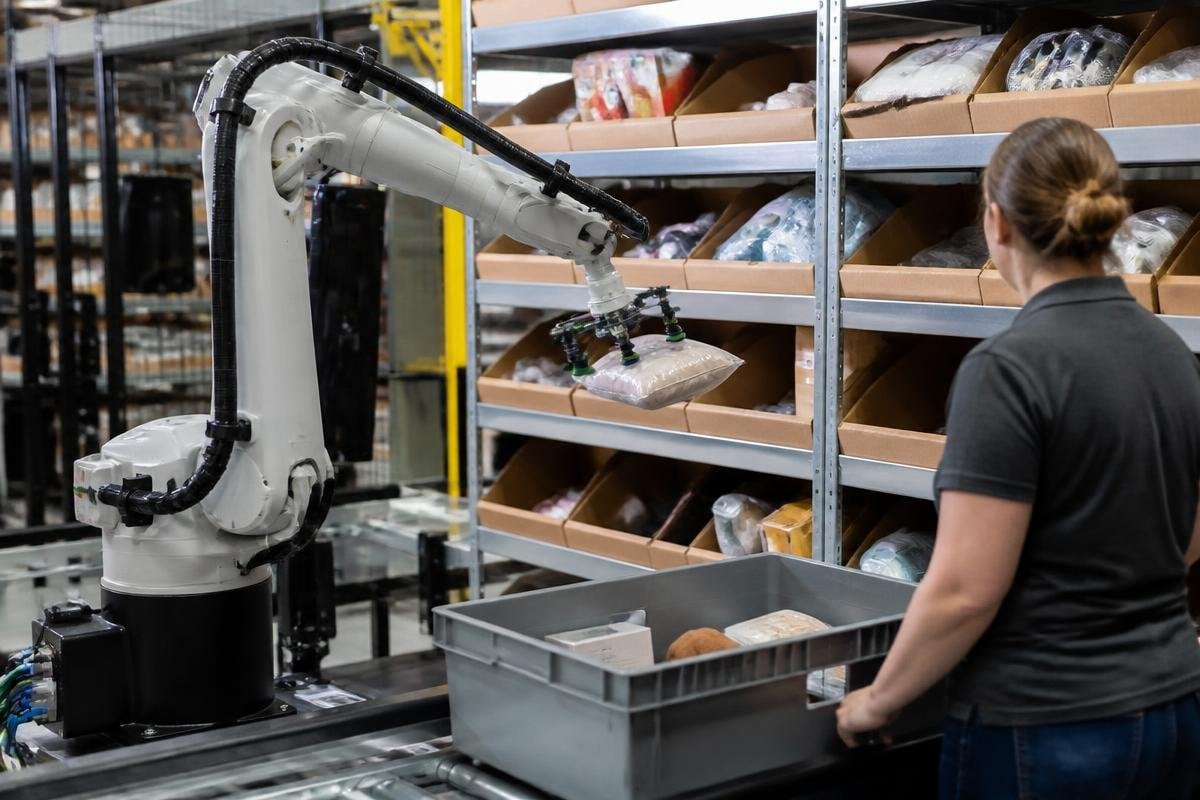
The robot can find a product, reach for it, and place it in a tote. The hard part starts when the item is soft, partly hidden, badly placed, or packed beside objects of different sizes.
For an operations manager comparing automation options, the useful question is simple: how much of the picking job can the robot handle without a person stepping in?
- Vision must identify items in changing positions.
- The gripper needs to handle different shapes and surfaces.
- Software must send uncertain picks to a person without stopping the whole line.
What the robot has to do
A picking system links several jobs. Cameras or depth sensors inspect a shelf or bin. Software estimates where an item begins and ends, then selects a grip point.
The arm moves an end effector, the tool at its wrist, toward that point. It still needs to control force during the pickup. Too little force drops a bag or box. Too much force can crush packaging or stop the item from leaving a crowded bin.
The robot also needs to check the result after the lift, since a successful motion does not prove that it picked the right item. That check can use another camera, weight data, or a view of the empty space left in the bin.
Each method answers a different question. A camera can inspect shape and labels, while weight data can show that something moved without proving which item moved.
Why picking robots will focus on uncertainty
Picking works well when the robot sees a clear object in a known place. Warehouse stock rarely stays that tidy. Products arrive with different packaging, labels face different directions, and one item can cover part of another.
This makes recovery more important than a perfect first move. The robot needs a safe response when its view is poor: change its angle, try another grip, place the item in an inspection area, or ask for help. A short pause can be cheaper than a damaged order or a blocked station.
The handoff between robot and person needs careful design. A worker should see the failed pick, the item in question, and the action needed. If the person has to search through a long queue or repeat work the robot already completed, the station loses much of its value.
What changes on the warehouse floor
A picking robot affects more than the arm beside the shelf. The storage layout may need wider access for the arm and clear space for bins. Software must connect inventory data, order queues, safety controls, and the robot’s status.
The system also needs a plan for items it cannot handle. Those items might go to a manual station, a different gripper, or a later step in the order. A pilot that measures only successful picks can hide the work created by exceptions.
The exception rate tells you how much work stays with people when a picking robot meets an odd-shaped item. Robot24 reports on the companies and machines behind these systems, giving you a way to compare pick speed with the manual work and damage left behind.
The next step is likely to be better coordination between sensing, motion, and human review. A robot that picks fewer items per minute may still fit better if it keeps the line moving and sends fewer damaged products downstream.
A practical buying checklist
Use these checks before comparing robot arms or software packages:
- Name the item range: include bags, cartons, flat products, and objects with loose or flexible packaging.
- Measure exception work: record how often a person must fix a failed pick and how long each fix takes.
- Check the handoff: watch what the worker sees and how many actions clear one uncertain pick.
- Test the full order: include item identification, pickup, placement, verification, and the next tote.
- Price the support system: count cameras, grippers, safety equipment, integration work, and training.
- Ask for unproven cases: identify which item types, shelf layouts, and order mixes still need a person.
I’d skip a picking system that reports only its best test cases. The useful number is the share of live orders it can finish, plus the time and labor needed for the rest.
Picking robots will improve as their software gets better at choosing safe actions under poor views and awkward grips. The practical test remains on the warehouse floor: how many orders reach the tote without a stop, a damaged item, or a person searching for the next fix?